Kenya’s community conservancies are rewriting the economics of safari, but control, consent, and carbon finance remain contested terrain
By Philip Mwangangi
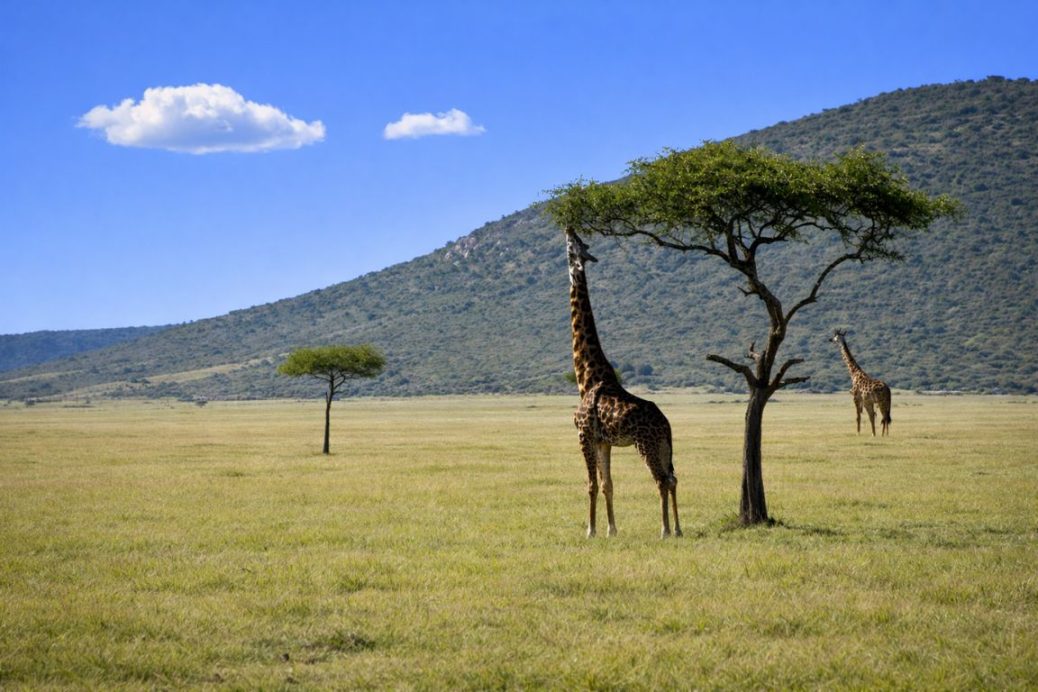
THE WILDEBEEST cross the Mara River in their millions each year, indifferent to the economics that their passage sustains. Around them, however, a subtle transformation in land tenure and revenue is reshaping who benefits from one of Africa’s most lucrative spectacles. In Kenya’s Maasai Mara ecosystem, a network of community-owned conservancies has emerged as both a conservation success and an increasingly scrutinised model of development finance, raising urgent questions about what it truly means for wildlife tourism to empower local people.
The Maasai Mara conservancies now cover over 400,000 acres of land, managed by 24 conservancies and more than 14,500 Maasai landowners. Together, they sit adjacent to, and in ecological terms are inseparable from, the Maasai Mara National Reserve, the state-managed park that drew 343,000 visitors in 2024, generating KES 5.6 billion (approximately $43.4 million) for Narok County. The conservancies operate on a different model: Maasai landowners lease their land to private safari operators, typically on 15-year agreements, in exchange for guaranteed monthly payments that replace or supplement the income from cattle herding.
Across the established conservancies in the Mara, lease payments amount to over $4.9 million annually, with an additional $46,200 estimated from ranger employment alone. The arrangement confers tangible advantages. Conservancies permit activities prohibited inside the national reserve: night drives, off-road game drives, and walking safaris. These command premium rates from high-end operators. Low bed limits restrict the number of tourists, preserving the sense of exclusivity that justifies prices that can exceed $1,500 per night. Wildlife densities in some conservancies rival or exceed those inside the reserve, according to research published in Biological Conservation.
The model’s most compelling feature is its ability to make wildlife economically competitive with livestock. Roughly 65% of Kenya’s wildlife lives outside national parks, on private and communal land. Without a financial incentive for landowners to tolerate animals that trample crops and kill cattle, the temptation to fence, subdivide, or simply sell becomes acute. The conservancy structure, in theory, resolves this tension. A new analysis from Maliasili, a Vermont-based NGO dedicated to bolstering local African conservation, found that 16% of Kenya’s total land mass is managed by its 230 conservancies, covering more than 22 million acres, an area the size of Indiana.
Kenya’s tourism sector underwrites much of this. In 2024, the country earned KES 452.2 billion from tourism, a 20% increase on the prior year, with the sector ranking as the second-largest foreign exchange earner after agriculture. The World Travel & Tourism Council projects that by 2035, the sector will contribute KES 1.8 trillion to Kenya’s economy, supporting over 2.2 million jobs. The conservancies are a meaningful fraction of this story, and the safari industry knows it.
Yet the model’s internal tensions are rarely aired at conservation conferences. There are growing reports of tensions between Maasai pastoralists and conservancy management companies, with allegations that original landowners are being excluded from decision-making and not receiving a fair share of profits. Research by Joseph Ogutu, a senior researcher and statistician at the University of Hohenheim, is sharper still. Land ownership in these conservancies is heavily skewed in favour of powerful and wealthy older men, the result of historical inequities in land subdivision. Women, with far less access to land ownership in a patriarchal society, are largely excluded, as are landless youth, meaning households that participate in conservancies derive higher incomes precisely because of historically unjust land tenure.
The governance challenge deepens when carbon finance enters the picture. The Northern Rangelands Trust (NRT), which supports 45 community conservancies covering over 10% of Kenya’s landmass in the north of the country, runs what it describes as the world’s largest soil carbon removal project. The Northern Kenya Rangelands Carbon Project generated approximately $3.9 million in 2023, with each of the 14 participating conservancies receiving $324,000 in their first payment from carbon credit sales. Corporate buyers have included Meta, Netflix, and UK bank NatWest.
The project has been criticised both for altering traditional grazing practices without adequate consent and for its methodology in quantifying carbon gains. A Kenyan court, in Osman & 164 others v Northern Rangelands Trust & 8 others, declared two NRT-linked nature reserves established illegally, citing shortcomings in community consultation. Verra, the world’s leading carbon credit certification body, placed the scheme under review twice, first in 2023 and again in 2025, before reinstating it. The NRT maintains that the court case relates to conservancy formation, not the carbon project itself, and that no legal decision has invalidated the project’s operations.
The affair is instructive. Carbon finance and safari tourism are converging as twin revenue streams for African conservation, but both can replicate extraction in a green register unless governance structures are redesigned from the ground up rather than retrofitted. Research on Enonkishu, a small conservancy of under 6,000 acres in the Mara ecosystem, shows how diversified revenue streams, blending livestock operations, homeowner conservation fees, tourism, and philanthropy, allowed it to withstand the near-total collapse of international tourism during the Covid-19 pandemic, when roughly 90% of Mara conservancies lost their revenue almost entirely.
Aviation is the sector that feels most acutely the pressure to demonstrate environmental credibility to the clients it delivers to the Mara. The International Air Transport Association estimates that sustainable aviation fuel could deliver 65% of the reductions needed for net-zero aviation by 2050. Yet global SAF production reached just one million tonnes in 2024, representing only 0.3% of total jet fuel demand, priced at two to five times the cost of conventional fuel, a prohibitive margin for airlines serving price-sensitive African markets. Corporate pledges to offer carbon-neutral flights to safari destinations remain, in most cases, exercises in offsetting rather than decarbonisation, with the integrity of those offsets contingent on exactly the kind of community consent issues that have bedevilled the NRT project.
British Airways and the African Wildlife Foundation have partnered to bolster Kenya Wildlife Service’s canine capacity to combat illegal wildlife trafficking at Jomo Kenyatta International Airport, a useful collaboration, but a narrow one. The larger challenge is whether corporate sponsors can move from transactional philanthropy to structural investment in community agency.
The conservancy model, at its best, demonstrates that wildlife conservation and rural development need not be zero-sum. Mara North Conservancy, which spans over 72,000 acres, operates as a not-for-profit partnership between 12 tourism operators and 783 Maasai landowners receiving direct lease payments, maintaining strict low-density tourism guidelines. Ol Kinyei Conservancy, established nearly two decades ago on Maasai-owned land, has become a model of sustainable tourism, with revenues supporting communities via land-lease payments, employment, and community projects. These are genuine achievements.
But the model requires honest accounting. Distributing the $2.5 million carbon community fund disbursed in 2024 across 205,000 people in participating conservancies yields roughly $12.20 per person per year. Lease payments, while more substantial, reach only those with legal title to land. The 65% of Kenya’s wildlife that lives beyond park boundaries does so on land whose custodians have rarely been the primary beneficiaries of the industry their tolerance of wildlife makes possible.
Africa’s safari economy generates billions. The question is not whether it can afford to empower local communities, it plainly can. The question is whether its governance structures, from conservancy boards to carbon registries to airline offset schemes, can be redesigned to make that empowerment real rather than rhetorical. The wildebeest, for their part, do not wait for the answer. ■


