
Vaccine distribution exposes the limits of Kenya’s devolved health system — and the ingenuity of those working within it
By Our Staff Writer
THE DRIVE from Lodwar, Turkana County’s administrative centre, to the nearest dispensary on its northern fringe can take several hours, depending on the condition of unpaved roads that swell into mud channels during rains and crack into corrugated dust in the dry season. A health worker making that journey carries vaccines in a foam-insulated cold box packed with ice. The ice, in temperatures routinely exceeding 35°C, does not last.
This is the central problem of Kenya’s immunisation supply chain, and it is not unique to Turkana. Across the country’s 47 counties, the infrastructure that delivers vaccines from national depots to rural dispensaries, a system of refrigerators, transport vehicles, trained personnel, and uninterrupted electricity, frays precisely where it is most needed. At the national level, improvements have been made: vaccines are now transported from national to regional stores in refrigerated trucks. At the county level, no equivalent upgrade has followed.
The gap carries a measurable cost. In Turkana County, the average distance a person must travel to reach the nearest health facility for vaccination was found to be 15 kilometres, three times the five-kilometre threshold recommended by the World Health Organisation. The WHO and UNICEF estimate that Kenya’s DTP3 coverage, the standard proxy for immunisation programme performance, rose from 82% in 2000 to 92% in 2019. But national averages obscure county-level divergence that is stark and persistent. Vaccine supply interruptions, including stockouts of the pentavalent vaccine, have periodically eroded public confidence and disrupted immunisation schedules.
The last mile
A 2023 peer-reviewed study published in the Journal of Pharmaceutical Policy and Practice, conducted by researchers at the University of Rwanda’s EAC Regional Centre of Excellence for Vaccines and the University of Nairobi, examined supply chain practices across 128 health facilities in Turkana County’s seven sub-counties. The findings revealed suboptimal vaccine storage and distribution practices in the last mile to rural health facilities, gaps which the researchers concluded may contribute to vaccine stockouts and hinder immunisation service delivery.
The same structural deficiencies appear in western Kenya. A 2024 study in Vihiga County assessed 86 public health facilities and found that only very few facilities had power backup for refrigerators, lower even than comparable rates recorded in Ethiopia and Nigeria. The absence of contingency power is not a minor operational shortfall; it means that a single electricity outage can compromise an entire facility’s cold stock. The researchers concluded that without addressing this, vaccine wastage and missed immunisation opportunities would persist.
Kenya’s devolution of health services to counties in 2013 was designed to improve local responsiveness. In practice, it has produced uneven results. In Nairobi County, only 1% of public health facilities have a reliable designated utility vehicle to collect vaccines and other supplies from sub-county depots. Wealthier counties can fund procurement; counties with narrower fiscal bases cannot. The result is a supply chain whose weakest links are in the areas of greatest epidemiological vulnerability.
Transport compounds storage failure. Vaccines must remain between +2°C and +8°C throughout the chain. The cold carriers used at the last mile have limited storage capacity, and improper conditioning of ice packs before transport risks freezing vaccines, which, if administered, may fail to elicit an immune response and require revaccination. Both heat exposure and freeze damage destroy potency but leave no visible trace. A vial that looks intact may be inert.
Local ingenuity
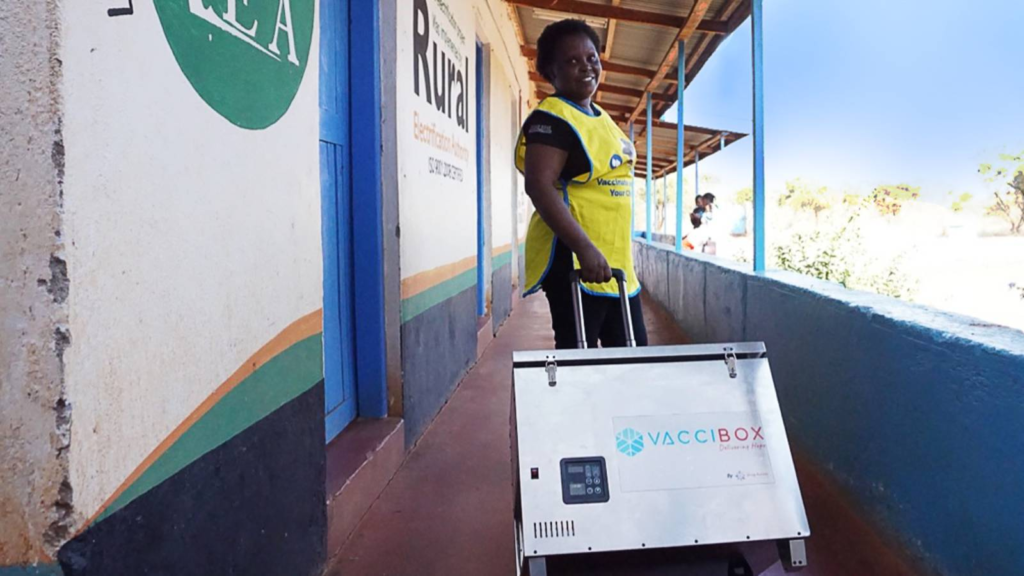
Against these systemic constraints, a pattern of local innovation has emerged. In Ngatu village, Kajiado County, approximately 80 kilometres from Kajiado town and with unreliable grid electricity, a community health volunteer has been using a portable solar-powered refrigerator called VacciBox since 2023. Before the unit arrived, ice packs in vaccine coolers would melt quickly in the heat; after its deployment, monthly vaccinations at the dispensary increased from 50 to 60 children to between 90 and 200.
VacciBox is manufactured by Drop Access Limited, a Kenyan social enterprise founded by engineer Norah Magero. Designed and built in Kenya, it maintains temperatures between +2°C and +8°C using solar energy and a smart battery backup. Its compact and portable design allows mounting on motorbikes, bicycles, or boats, making it suited for last-mile delivery to communities otherwise cut off from medical infrastructure. It incorporates IoT monitoring that tracks temperature, battery status, and performance in real time. In late 2025, the device was named a finalist for the Zayed Sustainability Prize. The company is now expanding into Tanzania, Zambia, and Côte d’Ivoire.

Nakuru County, in the Rift Valley, has taken a parallel approach at the government level. The county has installed solar-powered vaccine refrigerators at dispensaries in Gilgil, Kuresoi North, and Rongai sub-counties, with support from the Ministry of Health and UNICEF, as part of a commitment to reach off-grid and hard-to-reach facilities. County Biomedical Engineering Officer Kibet Keitany described the rationale plainly: “This equipment will provide continuous cold storage powered by solar energy, which we have in abundance.”
At the national level, a more systematic intervention was completed in 2024. The first batch of 200 new cold chain equipment items arrived in Kenya in December 2022 and was rolled out to health facilities through 2023, with installation completed by April 2024. Some of the equipment replaced obsolete household refrigerators that lacked WHO-prequalified temperature stability mechanisms. Susan Nakhumicha, Kenya’s former Cabinet Secretary for Health, described the exercise as an investment in equity: the unreached, the zero-dose, and the under-immunised.
Structural limits
Yet equipment alone does not resolve the deeper problem. A 2024 study of Vihiga County found that 57% of healthcare workers did not know how to identify all heat-, cold-, and light-sensitive vaccines, and only half could correctly interpret a shake test, the standard field method for detecting freeze damage in certain antigens. Training gaps persist even where hardware has improved.
The broader challenge is one of coordination between levels of government. Kenya’s national cold chain functions reasonably well down to regional depots. The Expanded Programme on Immunisation’s logistics backbone has benefited from Gavi financing and UNICEF procurement support. But the major bottleneck across African health systems is the disparity between urban and central cold chain capacity and what exists at the periphery. In many settings, vaccines must travel long distances from central hubs to health centres, often under unreliable temperature control.
Counties lack the ring-fenced budget lines, vehicle fleets, and technical supervision needed to replicate central standards at the periphery. The problem is institutional as much as logistical. Where county health departments have treated cold chain investment as capital expenditure rather than recurrent operational necessity, equipment deteriorates without planned maintenance, and trained staff are redeployed or leave without replacements.
What the evidence suggests
A 2025 narrative review of vaccine cold chain distribution challenges in developing countries, drawing on literature from 2008 to 2025, concluded that cold chain failures remain common despite decades of investment, and that innovations have not been consistently synthesised into policy. It identified a cluster of persistent gaps: inadequate infrastructure, limited workforce capacity, geographic barriers, and insufficient subnational financing.
The Kenyan experience maps onto each of these. The country has demonstrated, in counties like Nakuru and in enterprises like Drop Access, that solar-powered refrigeration at the facility level is technically feasible and commercially viable. What remains missing is a mandatory, funded cold chain maintenance standard at the county level, binding procurement norms for WHO-prequalified equipment, and a training regime tethered to immunisation outcomes rather than compliance checklists.
Kenya’s immunisation record is, by regional standards, respectable. The country was the first globally to launch the pentavalent vaccine with Gavi support, in 2001. But reaching 92% nationally, while leaving rural dispensaries in Turkana dependent on ice that melts before arrival, is not an achievement. It is an accounting exercise. The children who do not appear in coverage statistics are not counted among the missed; they are simply absent from the record. Fixing the cold chain is, in the end, a matter of making them visible.


